Kryptos K4: Recovered, Reconstructed, and Bounded
This is a sourced, multi-level reference to Kryptos, a careful reconstruction of the K4 message, and an open workspace to test ideas under one falsifiable standard.
What we have, and what we don't
The four anchor words, EAST, NORTHEAST, BERLIN, and CLOCK, are artist-confirmed and fixed. The remaining characters are a careful reconstruction, consistent with the anchors and with plausible English. The reconstructed mechanism is a Quagmire III variant with a physical keystream and a one-bit gate: the KRYPTOS keyword, the gate, and the helper letters come from the sculpture and public clues, while most of the substitution values are back-solved from the plaintext. The model reproduces all 97 positions, which is internal consistency, not independent confirmation. The reconstruction reads:
"The compass rose is here. East-northeast. This is your position. Commission Berlin Clock, which is northeast of here."
The message is simple. The key is not: it was a sealed, high-information chart, and mapping exactly where its boundary sits is what this site does. See the boundary.
Pick your level
The method now runs forward
The reconstructed method runs forward as a decoder. With no plaintext input anywhere, only the ciphertext, the tableau transcript, the declared cards, and the gate, the machine outputs the 97-character reconstruction exactly, anchors included. Two independent implementations agree, and a standalone script you can run yourself is in the downloads. This proves the written method is complete and executable. It does not prove every card value is publicly derivable: under our grading, 52 of 97 positions decode from derived or witness-claimed rules, and the remaining 45, mostly the Y-pass card, are explicitly isolated as the authored worksheet layer. The June and July 2026 anchor-frontier sweeps move the boundary further: f(P) and f(T) now close from public data alone, six g_Y cells are public-forced, and under the graded conditional ladder ( FPZ bridge, witnessed exception families) the back-solved count falls from 45 to 37.
The per-position grade map is on the verification page; the full forward statement is in the method.
What is Kryptos?
Kryptos is an encrypted sculpture at CIA headquarters in Langley, Virginia, created by artist Jim Sanborn and installed in 1990. It contains four encrypted messages. Three were solved in the 1990s. The fourth, K4, is 97 characters that resisted every public cryptanalytic attempt for over 35 years, until its plaintext was recovered from Sanborn's archive in 2025.
The K4 plaintext
The four anchor words, EAST, NORTHEAST, BERLIN, and CLOCK, are artist-confirmed and fixed. The remaining characters are a reconstruction: consistent with the anchors and with plausible English, and used to build the mechanism model, which means the model reproduces them by construction. They are not independently verified, and the authenticated plaintext recovered from the archive is not public. Roughly 24 of 97 positions are confirmed; the rest is reconstruction. We present the full 97 characters as a grounded reconstruction, not a confirmed transcription:
THE COMPASS ROSE IS HERE X
EAST NORTHEAST
THIS IS YOUR POSITION X
COMMISSION
BERLIN CLOCK
WHICH IS NORTHEAST OF HERE X
THECOMPASSROSEISHEREXEASTNORTHEASTTHISISYOURPOSITIONXCOMMISSIONBERLINCLOCKWHICHISNORTHEASTOFHEREX
The reconstructed mechanism is a Quagmire III variant with a physical keystream and a one-bit gate. The keyword is KRYPTOS, the same one used for K1, K2, and K3. The helper letter at each position is read from the tableau side of the copper screen at the same row and column. A one-bit gate then adds 1 or 0 to the shift, fixed by the position’s place in the grid. Turning a helper letter into the exact shift uses the helper cards, which are back-solved from the plaintext. P = (C − R) mod 26 holds at all 97 positions, which is internal consistency, not independent confirmation.
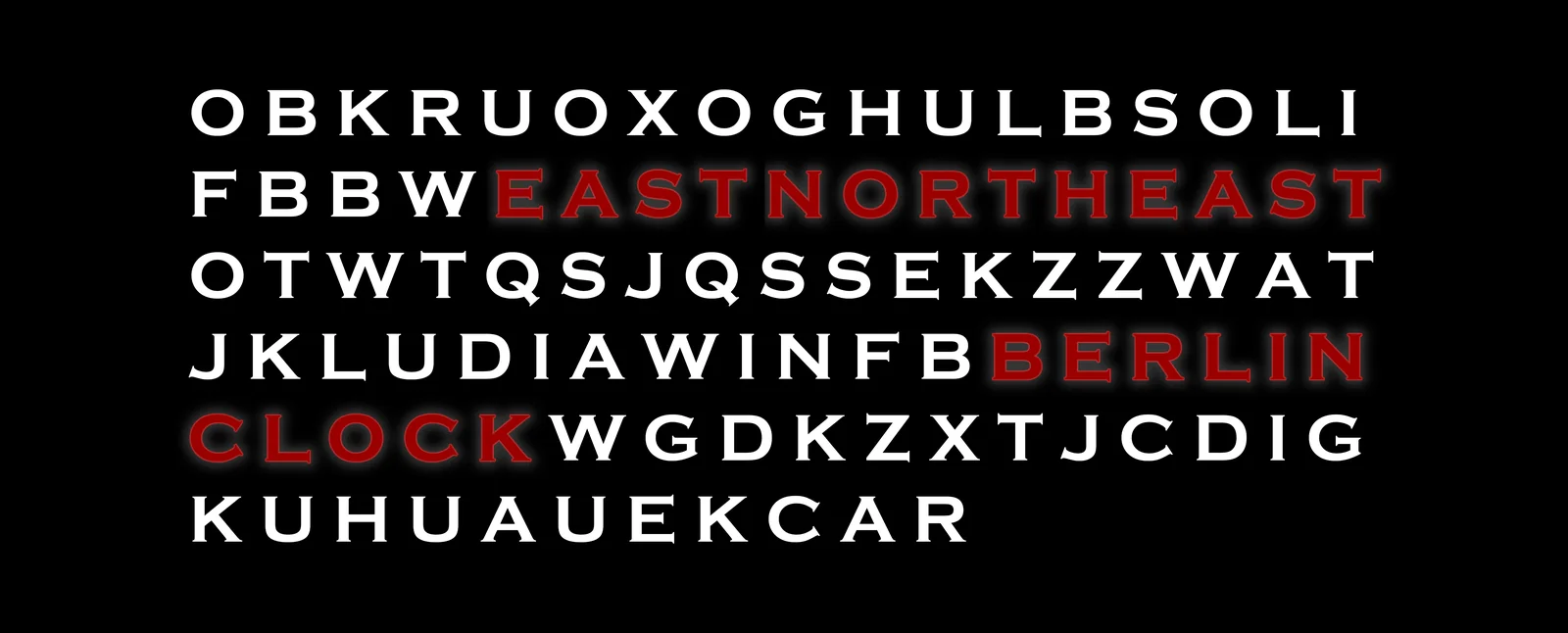
The highlighted anchors are artist-confirmed; the surrounding characters are reconstruction.
Why this is simpler than it looked
Sanborn has said for years that K4 should reduce to a simple puzzle, not a complex mathematical equation. He was right about the message and the on-site reading; the key chart is the part that stayed sealed. Once you have the sculpture (or photographs of both sides) and the reconstructed helper cards, K4 decodes in four steps:
- Step 1: The keyword is KRYPTOS. The same keyword used for K1, K2, and K3. The keyed alphabet is K R Y P T O S A B C D E F G H I J L M N Q U V W X Z.
- Step 2: The keystream is on the back of the sculpture. For each K4 ciphertext position, read the character on the tableau side at the same row and column. That gives you a 97-character physical keystream made of the cap WXZK, the full Y row, the full Z row, and the standard alphabet footer.
- Step 3: Apply the one-bit gate. At each position, add 1 or 0 to the shift. The gate value is fixed by the position’s place in the grid under a declared ray map, which is plaintext-independent by construction; its physical reading awaits a blind on-site audit. See the verification page for the exact rule.
- Step 4: Look up the shift and subtract. Turning the helper letter into the exact shift uses the helper cards, which are a reconstruction back-solved from the plaintext. Apply Quagmire III subtraction, the same mechanism used for K1–K3, and the reconstructed text appears.
Every prior attempt searched for a keyword for the keystream. In this reconstruction the helper letters come off the back of the sculpture itself, and turning them into shifts uses the reconstructed cards. We read Sanborn’s 2006 correction to K2, replacing the slipped ending “ID BY ROWS” with “X LAYER TWO,” as a likely hint toward the two physical layers. That is an interpretation, not a proof.
The full step-by-step reconstruction, including all helper-card values and the published structural signatures, is on the verification page.
Authorial-signature candidates (working theory)
The same helper-card layer that reproduces the reconstruction also yields two striking readings. Both are read out of the back-solved cards, so they ride on the reconstruction rather than standing independent of it. We keep them as working-theory candidates for deliberate authorial signatures, not as derived facts. The derivations and uniqueness tests are on the verification page.
AMID GRAY / I MAP J, an instruction inside the cipher
Take the difference between two of the helper cards (D = g_Y − g_Z1) and read it in the cipher’s own KYPT / ROSA basis. The result can be read as a four-part instruction:
A M I D G R A Y / I M A P J
AMID GRAY echoes K1 (“…the nuance of iqlusion”, work in the gray / shadow boundary); I MAP echoes K2 (map by rows / position); J is the entry letter. Read operationally, “I MAP J” performs a Gray-code map that sends J to X, the row where the active helper packet WXZK begins. We find the reading suggestive, but it is not uniquely forced; we present it as an interpretive working theory, not a derived signature.
SUB UMBRA FLOREO, an embedded motto
Read across 14 lanes, the Z-side helper cards spell a Latin phrase:
SUB UMBRA FLOREO
“Under the shade I flourish.” The phrase is exactly 14 letters, matching the K4 carrier’s 14 lanes, and the sculpture’s single blank cell falls precisely on its one letter E. It survives a strict boundary null, but two caveats apply: it is read from the back-solved cards, and the headline one-in-fifteen-million figure reflects one tested condition and does not account for how many card operations and bases were searched before it surfaced.
SUB UMBRA FLOREO is the national motto of Belize. Jim Sanborn’s father worked in cultural exchange across the Caribbean and Central America, and the phrase reads naturally as a personal tribute carried into the sculpture. Both readings are interpretive: the 14-lane register is a striking pattern, but it rides on the reconstructed cards rather than standing independent of them.
Full derivations and the other published signatures, including KRYPTOSA → IDQLNAME and ANDER → KYARX, are on the verification page.
"I want to understand the sculpture"
Start with what Kryptos is, walk the physical clues on-site, then see the K4 plaintext in context.
"Show me the reconstruction"
Go straight to the K4 plaintext with plain-English explanation, then verify the math position by position.
"I want to check the math"
Examine the cipher mechanism step by step, then independently verify every position with downloadable data.
The On-Site Field Guide
The four-step procedure to read K4 standing at the sculpture with pen, paper, a calculator, and the printed helper cards. A deeper view for remote solvers, working through the reconstruction from photos and the published cards, is included beneath the on-site procedure.
About the author
Matt Lacy is an independent cryptanalysis researcher and IT professional based in Ohio. SolveKryptos documents a multi-year structural reconstruction of K4, preserving confirmed anchors and publishing falsifiable claims for public review. Earlier versions of this site described K4 as solved; read what changed. The full verification dataset is available for download.